
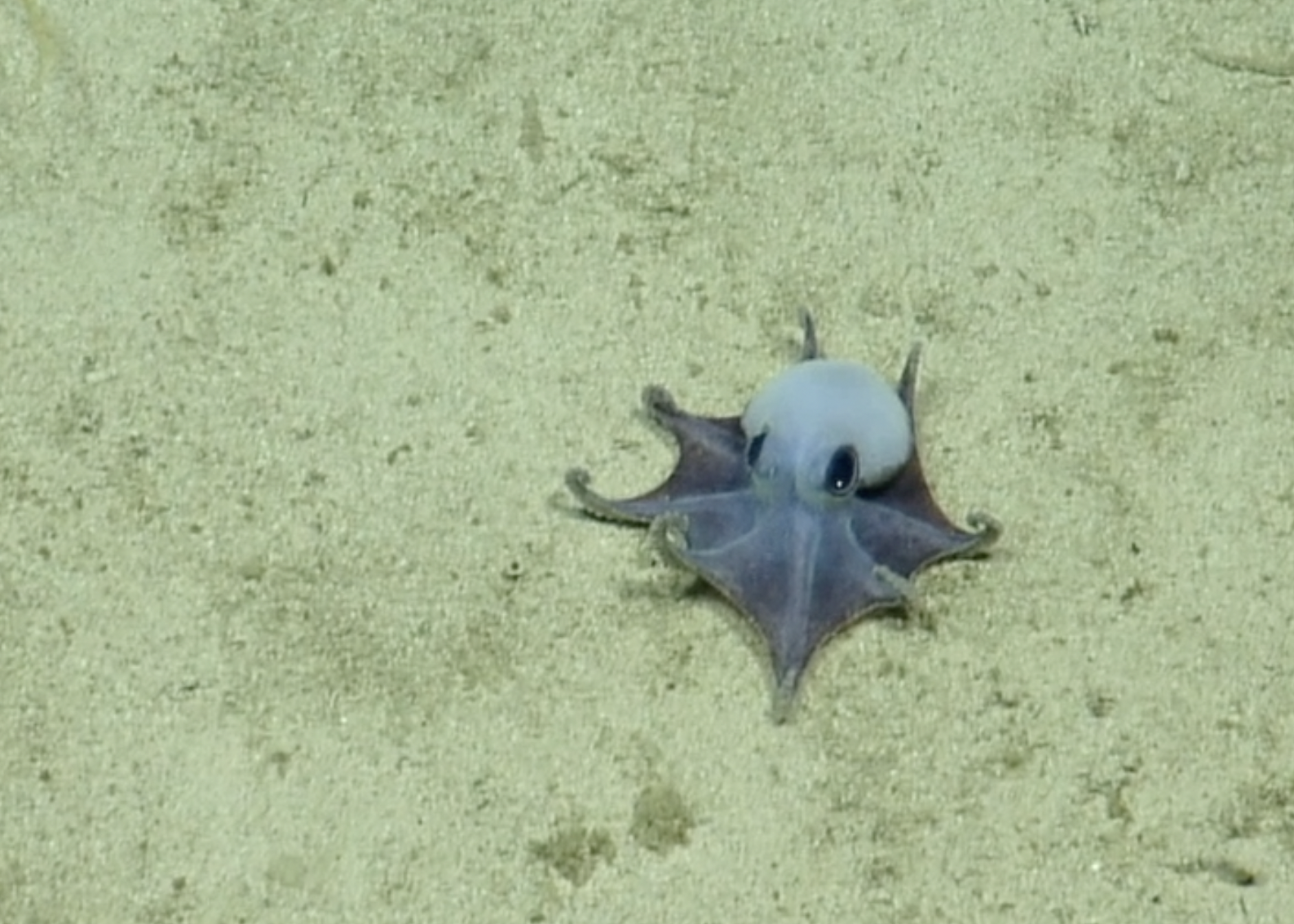
Nature can be a lot of things—beautiful, bloody, sweet, savage. And sometimes it’s just plain cute. For the latest example of nature at its most adorable, look no further than the little blue octopus—small enough to fit in the palm of your hand—just described in the journal Zootaxa, along with photos and videos of its discovery near Darwin Island in the Galápagos.
The little blue octopus was spotted in 2015 by researchers aboard the submersible Nautilus in 5,800-ft. deep waters. The sub’s remotely operated camera was visually combing the ocean floor when it caught sight of a flash of blue and zoomed in to spot a little eight-armed creature all alone in the water.
“He’s tiny!” exclaimed one researcher.
“It’s blue!” said another.
“Like one of those plushies.”
“Is that a cute little guy or what?”
The cute little guy, alas, was not long for his ocean world. The researchers scooped it up and brought it aboard the sub. It was then placed in a bucket of chilled seawater, and—as is common practice in collection expeditions—soon after immersed in 4% formalin, a toxic preservative, for 24 hours. After that, it was transferred to a 95% ethanol solution for storage, to be catalogued and saved in the collection of the Charles Darwin Research Station on Santa Cruz Island in the Galápagos.
There it stayed, unexamined until 2017, when researchers in the lab were going through photos of the station’s specimens, recognized the octopus as something different, and reached out to octopus expert Janet Voight, curator emerita of invertebrates at the Field Museum in Chicago, and the lead author of the Zootaxa paper.
“The were trying to come up with the species list it belonged to and contacted me,” Voight says. “I went through the photos and saw this one and it was like, ‘Wow, that is totally special.’”
Special enough that Voight requested the research station ship her the specimen so she could get a look at its innards—not with a scalpel and a microscope, but with a CT scanner, a system that the Field Museum had only recently set up. From the photo alone, the octopus appeared to belong to the genus Thaumelodone, a variety of small, squat octopus found in the deep waters of the southern hemisphere. That was just a guess, however, and Voight was anxious to see the specimen up close so she could make sure.
“It came down to really looking at the guts fully,” says Voight.
It took five years for the research station to agree to send the sample to Chicago and it wasn’t until 2022 that Voight at last got it on the CT scan table. At first, there was evidence that the animal was indeed part of the Thaumelodone genus. It had a zigzag pattern of suckers on its arms, which is a distinctly Thaumelodone feature. It also had no ink sac—consistent with a Thaumelodone, since in the darkness of the deep ocean, predators can’t see their prey anyway, so a defensive cloud of ink serves no protective function.
But there were multiple differences too. First there was the funnel organ. Octopuses can move at high speed by sucking water into an interior funnel and squirting it out like air escaping from a balloon. Inside the funnel of a Thaumelodone octopus is a small saliva gland, but in this case the gland was comparatively huge, wrapping its way around the entire interior of the funnel.
Then there was the texture. Thaumelodone octopuses are covered with small bumps, or papillae, but the little blue octopus was smooth. There was, too, the matter of the animal’s teeth—or tooth. Thaumelodone typically have seven teeth, but the specimen had just one large one. Finally came the color. The typical Thaumelodone is a shade of maroon. This one—while appearing blue under the light of an underwater camera—was actually white or even clear on top and purple on the bottom.
The verdict: the “blue” octopus did not fit at all in the Thaumelodone group, but rather in the Microeledone, a related deep-water genus—and it was reclassified accordingly.
So: does this matter—the business of what genus a dead, pickled critter belongs to? Maybe not.
“It’s not going to cure cancer or anything,” Voight admits.
But it’s a window—a glimpse into inky ocean depths that usually go unseen; a glimpse into a seemingly solitary animal that somehow ekes out a living there; a glimpse—and a reminder—Voight says, that there is biodiversity everywhere and it has to be protected.
An estimated 91% of all potential marine species have never been discovered, according to a 2011 study in PLoS Biology. Climate change, meantime, is endangering all of the aquatic life that’s out there, with the oceans absorbing more than 90% of the heat generated by greenhouse gasses, and about 30% of the carbon dioxide emissions. All of this is happening as disruptive offshore drilling increases at an annual growth rate of 6.2% and a burgeoning deep-sea mining industry in search of critical minerals gains momentum. In this environment, many undiscovered animals like the little blue octopus would not stand a chance.
“It’s the first deep-sea octopus from the Equatorial Pacific in the east,” Voight says. “It represents everything in the deep sea that we don’t even know exists. We talk about deep-sea mining but we don’t know what is there and we’re putting it all at risk. There are,” she adds, “extraordinary things” there.
from TIME https://ift.tt/e4K2AV5
Post a Comment