
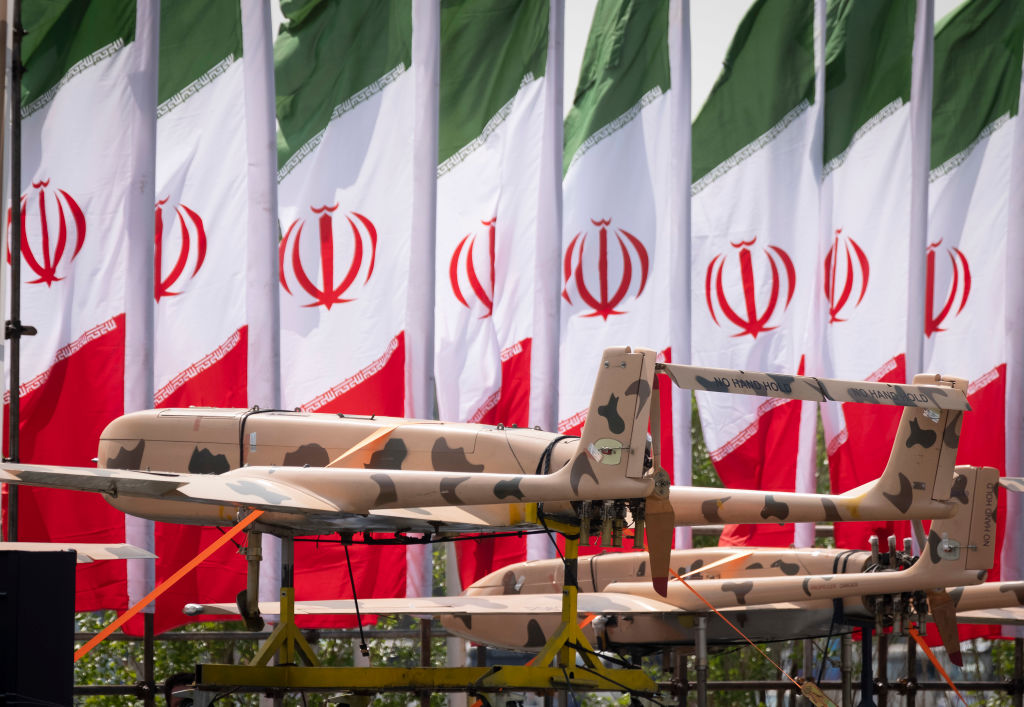
In the days since the U.S. and Israel launched the war against Iran two weeks ago, retaliatory strikes around the Middle East and a series of incidents labeled as potential acts of terrorism in other parts of the world have raised concerns about the possibility of Iranian attacks on U.S. soil.
Multiple U.S. diplomatic buildings or nearby areas in the Middle East have been struck by Iranian drones, and U.S. diplomatic missions in Oslo and Toronto have been targeted in attacks.
Read more: What to Know About Recent Attacks on U.S. Diplomatic Missions in Norway, Canada
In the U.S. itself, a gunman opened fire at a bar in Austin, Texas, the day after the initial strikes on Feb. 28, killing three people and injuring more than a dozen others in what is being investigated as a potential act of terrorism. The suspected gunman was wearing a t-shirt with an Iranian flag design at the time of the attack, according to officials, who said that the war was being investigated as a motive for the shooting. On Thursday, a pro-Iranian hacker group claimed responsibility for a cyberattack on major American medical technology company Stryker, saying it was “retaliation” for a deadly missile strike on an elementary school in Iran.
Federal authorities have reportedly issued warnings about potential Iranian attacks within the U.S. since the beginning of the war, raising particular concern about cyberattacks and transmissions that could activate “sleeper assets” outside of Iran.
In late February, the FBI also warned California police departments that it had received "unverified information" about Iran having “aspired” to conduct a “surprise attack” in the state using drones launched from "an unidentified vessel off the coast," ABC News first reported.
Read more: Could Iranian Drones Attack California? State, Local Officials Downplay Threat
Experts tell TIME that Iran has the capability to carry out attacks in the U.S. by several means, including through cyberattacks and various groups or individuals it has forged connections with in North America, and that retaliatory efforts could persist even after American strikes in the Middle East end.
But John D. Cohen, who acted as the Under-Secretary for Intelligence and Analysis during the Obama Administration, explains that the U.S. is well prepared to handle these potential attacks.
“While the threat is very significant, the good news is that the level of understanding and sophistication, especially amongst state and local law enforcement, has increased dramatically over the last decade and a half,” Cohen, who also served as the Counterterrorism Coordinator for the United States Department of Homeland Security (DHS) under Presidents Barack Obama and Joe Biden, tells TIME.
He also says, however, that the federal response has been “a little disappointing thus far” and that there has been a decrease in intelligence briefings to state and local law enforcement and in the resources the federal government allocates toward countering cyberattacks.
“At the very time when the threat environment has increased, or become more volatile, federal resources and the federal information-sharing activities that are critical to combating that threat or mitigating the risk from that threat have been diminished,” Cohen tells TIME.
TIME also spoke to Bruce R. Hoffman, a counterterrorism and insurgency expert who has served in advisory roles to multiple federal agencies. He was appointed by Congress in 2013 to serve as a commissioner on the independent commission to review the FBI’s Post-9/11 Response to Terrorism and Radicalization.
Cohen and Hoffman discussed the potential threats Iran poses to the U.S., its use of proxies, and how the current risk of attacks compares to that during past U.S. involvement in Middle East conflicts.
The following interviews have been condensed and edited for clarity.
Q: What capability does Iran have to attack the U.S.?
Cohen: Iran currently has operational capabilities to attack the US in several ways.
One, Iran has created a global cyber attack capability, working closely with countries like Russia, and they direct cyber attacks against state and local government, [the] U.S. federal government, critical infrastructure, information and communication systems here in the United States.
Secondly, Iran has an extensive presence in Canada, Mexico, Central America, South America, where they have both [Islamic Revolutionary Guard Corps (IRGC)] and intelligence service personnel. They work closely with criminal organizations within the United States to conduct physical attacks …
Iran also has an extensive information operation capability and has regularly sought to inspire, inform, even facilitate destructive and violent activities within the United States by posting online content and exploiting divisive current events for the purposes of enabling and facilitating destructive and even violent demonstrations.
Hoffman: We don't know, actually, [what capability Iran has to attack the U.S.].
Over the decades, there have been reports and, in some cases, arrests of Iranian sleeper agents in the United States. However, over the past decade plus or so, it seems that those assets, if they did exist in the U.S., have atrophied, because Iran increasingly has turned to alleged drug cartel members or people who have connections with narcotics cartels, organized crime figures, biker gangs, both in the United States and in other countries, as well as paid-for-hire assassins or kidnappers.
And whether that's good trade craft in somehow concealing Iran's direct involvement, or whether it reflects the inability to mobilize actual resources in the United States and the other countries affected, we don't really know.
Q: Compared to other wars in the Middle East the U.S. has been involved in, how is the threat to the U.S. different this time around?
Hoffman: It's different in a number of respects.
Firstly, after … nearly two decades when terrorism was seen as among the preeminent threats to US national security, since 2018 terrorism has not occupied that place of preeminence. It's now seen as of one of many other threats to the United States. And consequently, over the past eight years or so, we've seen resources, especially following the defeat of the ISIS caliphate, we've seen resources shifted away from counter terrorism to counter intelligence and to other threats from peer competitor nations or from rogue states like Iran.
More recently, of course, there has been an exodus of individuals from law enforcement, federal law enforcement and the intelligence community with particular expertise, long careers spent on this particular threat with immense knowledge, who have either voluntarily left government service or been forced out of government service.
And then finally, insofar as there's a national security threat that has preoccupied the domestic United States, over the past year or so, it's been illegal immigration, not so much terrorism, although there is a terrorist element to that. But of course, resources have been shifted away from counterterrorism to countering illegal immigration.
Q: Are there scenarios you think are more likely than others?
Cohen: Experts that we worked with going back to 2011 and up till currently, they've always said that if you want to understand what Iran is going to do, look at what's being done to it. And so Iran is typically very careful not to go beyond the tactics that have been employed against it. So as we're looking at the current conflict, we're seeing the targeting of government officials within the Iranian military and intelligence infrastructure and even its leadership. We're seeing the targeting of petrochemical facilities. We've heard that there were cyber attacks deployed early on as our military assets were conducting their initial attacks. Those are examples of what we did to Iran, and which we should be anticipating that Iran could do in response …
It's always described as symmetry, but the underlying principle in preparing for attacks from Iran is that they will typically engage in attack activity similar to what was done to it.
Q: Does Iran have the infrastructure or intelligence to replicate U.S. attacks?
Cohen: Yes, while not on the same scale, Iran does have the operational capabilities to replicate many of the attack techniques used against it. It has an extensive global cyber capability. This is a capability [that’s] not just located in Iran, but it involves groups and individuals located across the globe. It has a network of operatives, whether they be part of Iran's military or intelligence organizations, proxy groups, criminal organizations, that are spread across the Western hemisphere, including in the United States, Canada, and even south of the border …
And they've had over a decade to develop and refine their playbook and incorporate new emerging technologies such as AI and even sophisticated drones into their attack scenarios.
Q: Can you explain the threat of Iranian proxies to the U.S.?
Cohen: Iran has developed strong financial and operational relationships with groups like Hezbollah [in Lebanon], the Houthis in Yemen, Hamas [in Gaza], and even criminal organizations where they will use these groups or operators associated with these groups to engage in acts of targeted violence or cyber attacks. When looking at different physical attack scenarios involving Iran, what law enforcement is concerned about would be the potential for attacks by operatives who work directly for Iran's military or intelligence services; attacks planned by the Iranians but conducted by one of these terror groups, such as Hezbollah; or the use of criminal organizations to conduct these types of operations so that Iran can maintain some level of plausible deniability. So the attack would be conducted, but Iran would be able to be removed from association with the attack.
Iran also has sought to leverage individuals who are unaffiliated with either a proxy group or the Iranian military or intelligence organizations and sought to influence the behavior of people by posting online content intended to inspire those people to act, to conduct an act of violence.
Q: What capability does Iran have to carry out drone strikes on the U.S.?
Cohen: The first point is, we're not talking about Iran shooting drones from Iran and striking the U.S. Iran has a significant presence in Mexico, Central America, South America, Canada, even the U.S., through its military and intelligence operatives, its proxies, its relationship with criminal organizations, in particular those operating south of the border. They have the ability to access the expertise, the personnel, the equipment to conduct a drone attack in the United States, and now they have the incentive.
We know that Iranian intelligence and military IRGC operatives have worked in the past with Mexican drug cartels. A number of these cartels are actively using drones to deploy explosives as they conduct assassinations of their competitors. So at the very least, we know that criminal organizations in Central and South America, as well as terrorist organizations, are using relatively unsophisticated drones to conduct surveillance, to transport lethal substances and to deploy explosives. So it's not hard to imagine that an Iranian military or intelligence operative could acquire one of these drones and use it to conduct a lethal attack.
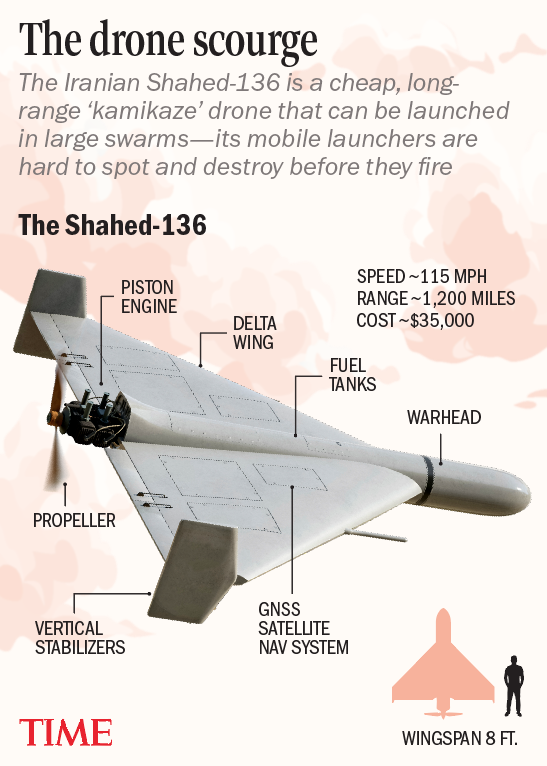
Hoffman: Certainly [with] the Shahed drones, Iran has perfected a particular lethal variant of a suicide drone, as well as various other ones that have been used … There are all kinds of drones. They come from large to very small to even micro. So they're certainly very portable and easily transportable, so they could be brought into the country, smuggled across the borders, for example, whether the northern or the southern border, and launched from within the United States …
It could also be, as we're reading reports, conceivably, that an offshore maritime vessel could launch them from the Pacific.
So I think that there's a range of possibilities. The bottom line is, it's very difficult to defeat drones. … In general, it is only uniform federal law enforcement that has the authority to shoot down drones, or the military … So this is a problem that could very easily overwhelm state, local, and tribal authorities very quickly, who don't have those authorities … There's not a clear line of defense against drone attacks, which increases their attractiveness to Iran or any enemy.
from TIME https://ift.tt/9BZ0g4H
Post a Comment